
I was recently speaking to an acquaintance who expressed frustration that the media environment is “all biased” and wished to find “unbiased” news. Neighbors of mine have also been desiring a balanced source from which to derive news, specifically on the hopes of better understanding right-wing perspectives, the power of which they feel they have underestimated. People of the leftish persuasion often want to feel as though they are getting a bird’s-eye-view of things, lest they be accused of hanging around in one of those echo chambers. Maybe people of the other persuasion just don’t care—I don’t know. But if you find yourself wishing that the news would stop being so political either way, this post is for you.
Maybe I am in the minority, but I actually believe the current problem with media is not the lack of politically neutral reporting. The entire notion of “unbiased news” is a little nonsensical to me at the outset. First off, I hate to say it, but facts are boring. You may think you love facts, but hardly anyone does. And that’s because facts tell no story. Take for example, the Supreme Court recently voted 4-4 in response to an online Oklahoma Catholic school’s bid to become a public charter school. This means that the Oklahoma Supreme Court’s ruling against the Catholic school will remain in place. Now, many people who have been following this and have ideas about the separation of church and state in this country will find that important and interesting on its face, but most Americans have not been following the case nor have any idea how to parse this. The vast majority of the reporting on this makes some set of claims about this decision that make it actually interesting.
Even outside of the opinion section, most of the articles covering the decision speculate that Chief Justice John Roberts sided with the “liberal” judges (we do not know this for certain) and others speculate that the case was swiftly cast aside due to the overwhelming volume of emergency appeals the Trump administration has been throwing their way. (Probably! We don’t know that for sure either!) You may read any number of these articles that simply describe what has happened and use your own analytical tools to come to some conclusions about it, but most people want to read an analysis because that helps you put everything into context and sometimes tells you how to feel. Fox News tells you that the decision is a “blow” to religious charter schools. (Psst, blows are bad!) I had to close out about 7 million ads on the Fox News website to read the article, but the rest was pretty neutral, covering as much factual information as the NPR article on the same event.
In fact, I’d wager that if I read mostly Fox News, I’d still be as big of tree-hugging leftist as I long have been. The biggest difference between “right-wing” and “left-wing” news sources is not really how they cover news, but what they cover. On the Fox homepage right now, for example, is the headline “Leo Terrell vows to ‘eliminate’ antisemitism as Trump targets Harvard.” This headline is filed under something called Fox News Flash, which I guess is some kind of opinion-laced breaking news kind of vertical. Terrell is Trump’s sycophantic goon in charge of the bad faith crackdown on antisemitism. The article mostly quotes Terrell who parrots the absurd talking point that Harvard ought to lose federal funding for (primarily) medical research as punishment for the school’s alleged failure to do anything about some students having opinions about Gaza’s destruction. I had to look up Terrell to make sure I know who he is because I am under the impression it doesn’t really matter who he is. I don’t hear much about the henchmen of Trump’s goose step brigade because they’re just Trump mini-me’s—if they are fired, they’re just replaced with an identical one.
But Fox’s reporting is factual: it directly quotes Terrell. It isn’t misleading in the slightest. What is slanted is covering this interview at all, which suggests both the importance of the interview and the validity of his claims. NPR, on the other hand, doesn’t find this very newsworthy. The top headline on its homepage is (correctly, imo) RFK’s announcement that COVID shots are no longer recommended for kids and pregnant women, despite mountains of research that the vaccines benefit them. This story is buried on the Fox homepage under the headline “CDC removes COVID vaccine recommendation for healthy children and pregnant women.” (As I am pulling these articles up, I want to note that the number of times Fox has crashed my browser is now twice). The Fox article is, again, actually strictly factual. It directly quotes RFK, NIH Director Jay Bhattacharya, and FDA Commissioner Dr. Marty Makary. Makary says there is no evidence that “healthy” children need the vaccine and that “most countries have stopped recommending it for children.” If I didn’t know any better, I’d think this reads simply as a press release of a fairly inconsequential bureaucratic decision. NPR, on the other hand, wants you to be informed about what this may mean going forward: “The decision will make it much harder for parents to get their children vaccinated and for pregnant people to get the shots because insurance companies will likely no longer pay for them.” Additionally, NPR lets you know that the decision “was apparently made without the usual input from independent outside advisers,” and links to research that contradicts the claims of the goons. The NPR reporting is a far more substantial piece of writing, bringing in context and commentary from leading medical professionals who express dismay. This makes the piece more biased than the Fox News report, but I’d argue that the bias is extremely important.
If you weren’t already aware of the mountain of evidence in favor of vaccinating children and pregnant people, or if you’re under the impression that RFK is a smart, reasonable fellow, then you might be inclined to believe that this change in CDC policy is being made in good faith by experts who know better than you. That’s a reasonable assumption to make, one I have certainly made in the past about people I assumed know better than me. In this case, Fox News comes ahead here in the Unbiased Games, making for actually far less compelling reading—you know, just boring facts. This guy said this, this guy said that. Snore.
And maybe that’s actually the issue.
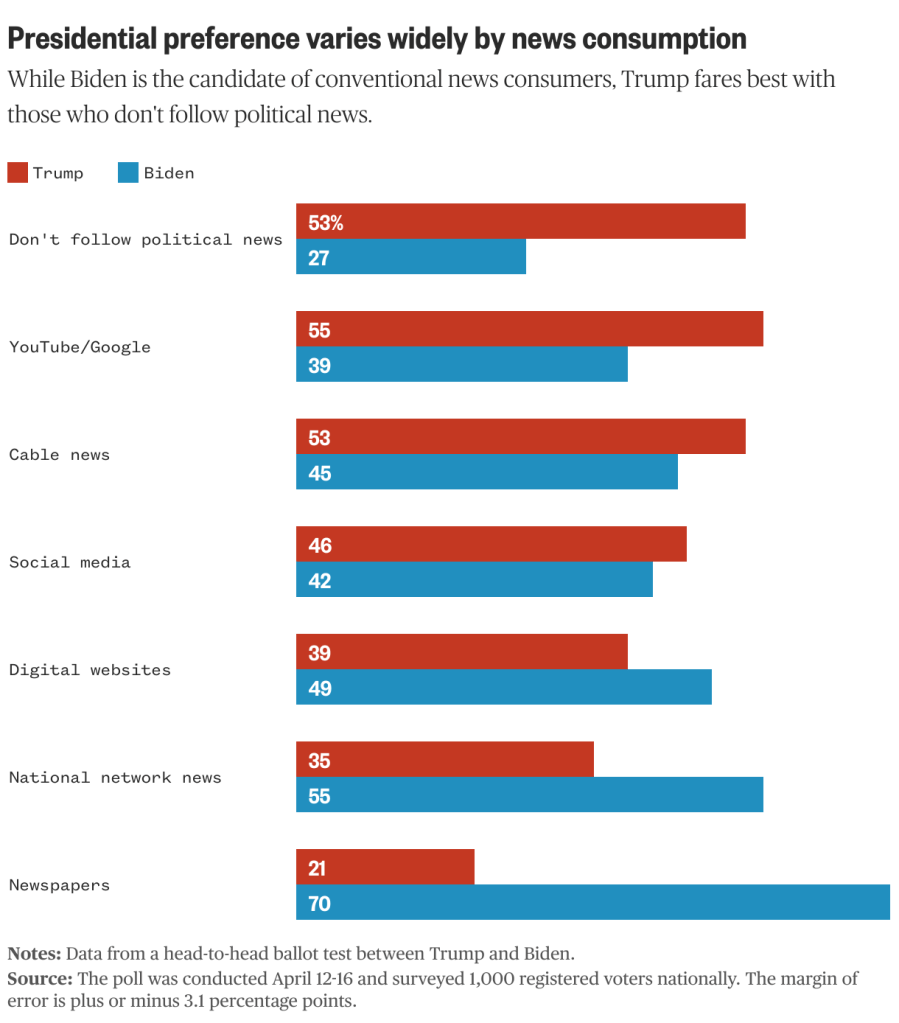
Many, many Americans do not read political news at all. Probably because a lot of it is pretty boring unless it does the actual work of trying to convince you that something is important and worth your time and attention. It’s way more fun (or upsetting, take your pick) to read an opinion piece, something that’s trying to get your blood boiling, something that’s making you want to smash that repost button.
This is where I want to argue that there’s nothing wrong with reading essays or opinions or even whatever the fuck a Fox News Flash is. I read mostly opinion pieces. And yes, they’re biased. I read opinions that are pretty well-argued but still don’t like; I read opinions I agree with but concede that they don’t argue it very well; and I read just bad takes all around. All news is biased: the choice to cover one thing and not the other; the choice to interview one person over a different person. The important thing to remember is that it’s all an argument and you are the ultimate judge over whether they have made a convincing one.
For all the talk about liberals complacently consuming their little lefty media without a care in the world, liberals tend to read pretty widely and sometimes try to uncover counterclaims and counter evidence. If you’re of the right wing persuasion (uh, hi?), I have to ask how often you think of yourself of skeptical. Not skeptical in the sense that you hear about a supposedly nice thing Biden did and you’re like “ha, I doubt it!” But skeptical in the sense that you read something that’s telling you that people in this country without formal documentation (“illegal”) are out there killing people left and right and you thought “are undocumented people more likely to commit murder than other people?” I asked Google that question and got this little summary: “Based on the research available, there is no evidence to support the claim that undocumented immigrants are more likely to commit murder or other crimes than native-born citizens. In fact, several studies indicate the opposite,” with some citations. On the subject of vaccines, you could search “what evidence is there to support vaccinating pregnant women for COVID?” There’s a bunch. Then you could decide whether or not it’s reasonable that the CDC no longer recommend these vaccines. Wouldn’t it be flattering to your ego to appoint yourself Media Judge and cast doubts on everything you read and hear, do your own little fact checking, making sure you’re not just eating from the Media Feedbag full of bullshit? Ugh look at me trying to reach across the aisle.
It’s not a given that whatever you’re reading is going to answer these questions for you or give you the proper context to analyze what is going on. It is unfortunately, on you to think of these questions and do some subsequent research. It is also unfortunate that at this moment in time people “doing their own research” has also led to people finding some garbage sources that confirm whatever fringe opinion they already had. Don’t do that either. Basically you need solid reading comprehension skills to exist in the world and consume media thoughtfully. That requires some work! Everyone has heard the lesson that teaches you to distinguish between fact and opinion. But that’s some barely-awake brain shit. We live in galaxy brain times. Facts are generated by consensus of opinion, opinions are social facts. Statistics aren’t objective! Facts do care about (reflect) your feelings! To start, you need to constantly ask yourself questions as you read. What are they suggesting here? Do I believe that? Did they provide evidence? Is there counter-evidence? Who are their sources? It takes constant practice to learn to think this way, but boy it’ll make you far less of a mark, far less of a fucking pawn.
Offsetting the labor of having to actually think about shit in America onto citizens is actually by design. Casey Johnston argues this kind of started back when the US government allowed deregulation in the food industry in the name of “innovation,” and allowing manufactures to “inform” consumers about their food in the form of the opaque, inscrutable nutritional label. The result has been only those with time, energy, and a robust education can ascertain that the product in their hands is primarily partially hydrogenated soybean oil and “butter-flavor” and not actually “food” in the proper sense. When you’re consuming information are you reading the figurative nutritional label and asking what’s the fuckin difference between soluble and insoluble fiber or are you just chowing down?
I think that, actually, most people don’t know what they mean when they complain about “bias” in the media and yearn for “balanced” news. I think what they’re trying to express is frustration for being taken advantage of, or frustration with how hard all of this is. To which I have to sympathize. It certainly would be nice to open up the newspaper in the morning (lol) and get a whole bunch of very well-argued articles with proper citations that help you feel informed and also taken care of—because some people who know better than you sifted through all the bullshit and decided which things you ought to hear about.
My advice for now, if you feel this way, is to buy a physical magazine or a newspaper (yes, actually) that you remember existing when you were a child, whether that be in the early 2000s or in the 1950s. There used to be something simply called tabloids, which everyone knew were downright fake, but could still be fun to read. Think of most of the internet as a tabloid, to be taken with a giant grain of salt. For all the faults of old “legacy” media, most of them still operate in a relatively sane universe. Even the Washington Post is a decent jumping-off point to knowing what’s going on right now of importance. Start asking some questions and if you feel lost, ask someone you trust knows better than you to help you sift through the bullshit.
 Britt H Young