The first time I saw the world according to Nancy Drew, it was filtered through a Compaq CRT desktop computer monitor. The sounds she heard were pumped through those little Stonehengey speakers with the big volume dial that lived on all our desks. Her thoughts—always uttered allowed and transcribed in front of you. We know Nancy eats because the screen reads “*Nancy eats*” and we know she enjoys it, every lip-smacking bit. All of the Nancy Drew point-and-click mystery computer games, from the first in 1998 up to 2024, are shown from Nancy’s POV, from Nancyview, if you will. “It’s up to you, as Nancy Drew,” the games’ intro credit sequence whispers. For the player, the process of becoming Nancy, however, widely varies. In the first game I ever played, Message in a Haunted Mansion (2000), Nancy is exploring the halls of a dilapidated San Francisco Victorian in the middle of a renovation by two aspiring inn-keeper lesbians friends. From the moment Nancy emerges from her gorgeously appointed New Age bedroom, she is bombarded with a relentlessly spooky score. Whines of an out-of-tune saloon piano, a strangely resonating organ, and all the creaks and bumps and bangs. Probably a whole two minutes into the game, as Nancy descends the grand staircase, she—err, I—hear a ghostly voice whisper “I see you.” Terrified out of my goddamn mind, I bent over from the office chair and pushed the eject button on the CD-ROM, killing the audio instantly but leaving the frame of the carpeted hallway frozen on the screen. I wouldn’t load the game again for several years.
Turns out, it was easier to become Nancy—fearless, incisive, unflappable, often sleepless, sometimes hungry—with a friend by my side. When being Nancy came to be too much, my buddy Ross and I would take turns steering the teen sleuth. Like with Being John Malcovich, the consumer of Nancy Drew games must accept a level of campiness. Nancy, who is canonically nineteen or something, is flown around the world to investigate hauntings, robberies, murders, and other straight-up bullshit and yet is viciously castigated by her clients if she so much as picks a slightly unripe tomato for tonight’s supper. (Honestly, fair.) Throughout the Nancy games, she must perform uncompensated menial labor, (despite often being hired to solve a mystery), answer to some of the most incompetent adults in human history, and question people who would like to see her dead. In every game, there are various ways Nancy (I mean, you) may die. Primarily, you can be fired, which is functionally the same as death (such is life under capitalism, blah blah blah). But you can also mix up the wiring on a boat engine, get crushed by a boulder Indiana Jones-style, drown under ropes thrown on you by a remotely controlled robot, be swallowed by a giant pitcher plant, etc etc etc. And when it isn’t deliberate camp, it’s the impossibly strange stylistic decisions and professional failures of the team at Her Interactive, a small video game outlet based in Washington (love you guys, I’m sorry). Someone over there failed phenomenally in programming the hit boxes for Nancy’s gimpsuit stripper dance performance in Paris. The things this girl will do for money.

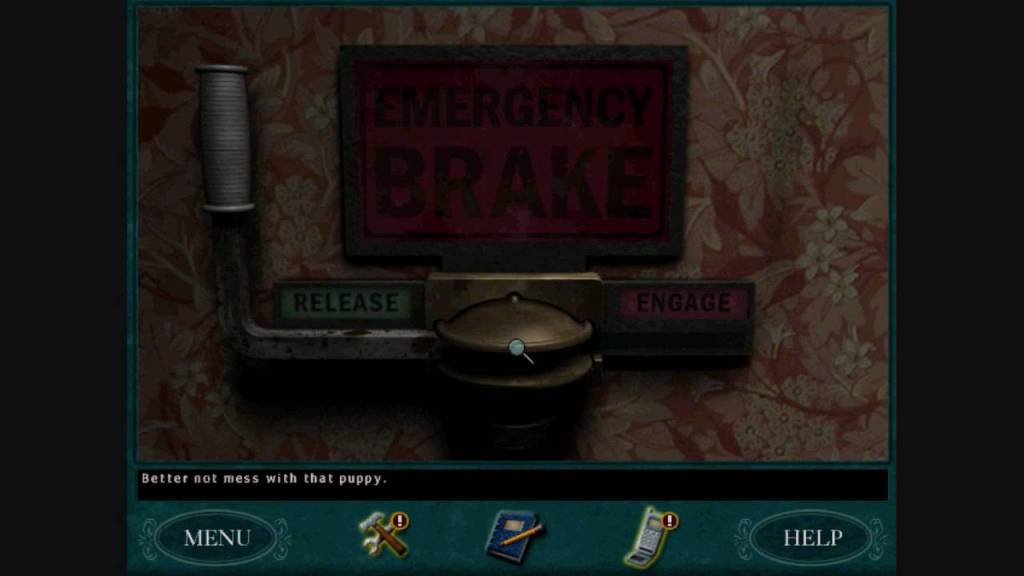
I started replaying these games from my childhood in 2020, when I was decidedly very not-Nancy. At the time, I was defeated. The pandemic had eviscerated my plans to conduct fieldwork in Ethiopia for my PhD. I couldn’t carry on with the degree I had been working towards for 5 years, I had stopped exercising, and instead committed to full-time wallowing (and eating sourdough bread). Like a lot of people, I started doing things I had no time to do before, like spend all day cooking for no reason and for no one. Nostalgia called to me. I had been meaning to introduce my partner to the Nancy Drew games and figured it best to start with Last Train to Blue Moon Canyon (2005). Famously, it has my favorite Nancy Drew line of all time: “better not mess with that puppy,” she utters to herself when you suggest she pulls the emergency brake on the 19th century steam train, (you do pull it, you do die). Doing whatever the hell you do on that Last Train (I hardly remember, Nancy plots almost never make any sense anyway) was better than doing whatever the hell was not going on in my life. We finished that Nancy and picked up ones that came out since I was a child—from 2011 and 2014—and while they didn’t make more sense, they got richer and weirder and sometimes actually scary. I was hooked.
They say that as you get older, you become more idiosyncratically yourself. I think if you got COVID, that process accelerated, both literally and kind of symbolically. You were a little forgetful and a little hapless before? Now you’re even more unmistakably so. Our defining quirks, unrestrained by social conformist pressures, sedimentized in the solitude of our living rooms. They are now, your brand. The world of Nancy games is similarly so essentialized, so distilled, that it can only be explained by Her Interactive’s original mission as an educational game company for girls. If Nancy travels to the midwest as an undercover intern for a university tornado research team, you bet she’s going to encounter non-stop tornadoes. If she visits New Orleans, then she’s of course spending all her time at voodoo shops and cemeteries and eating gumbo. It’s like she gets the quintessential tourist experience, a la Carmen San Diego, conducive to learning, ie. associating certain places with a reducible set of keywords. You can go to tornado alley and not see a single tornado, but not in a Nancy Drew game, where if it could happen it will happen, because otherwise you wouldn’t be learning, right? But you also wouldn’t be becoming Nancy Drew, either, if you don’t do as she does and survive tornadoes and sinking ships and burning sheds and men who are “gonna get ‘cha.” Nancy is who she truly is in those moments—freaked out for sure, but clear-eyed, determined, and undefeated. She dies, she just comes back. You get to try and try again to be Nancy until you get it right.

Over the last 6 years, I have chosen again and again to be Nancy, mostly when being me was too much. The world of Nancy is, as we say in the very serious gamer community, heavily rail-roaded. In a time dominated by open world games, Nancy games are not just their antithesis, but the antidote. Screw infinite choices, skill trees, moral quandaries, and alignments—in a Nancy game you’re fucking Nancy. The greatest leeway you’re given is how many times you want to ask the grieving family member about their dead mom, and there’s still a limit! Sometimes it is not clear what to do next (because, let me be clear, these games are not very good), but there’s often only one thing to do next. This isn’t choose your own adventure; you rarely get multiple options for dialogue; every ending is the same. Ninety-nice percent of the time, you end up discovering a secret final place underground where the villain tries to kill you, you die a few times trying to figure out a badly programmed mechanic, you live, you write a letter to your boyfriend Ned about how you figured it all out and you’ll see him soon (Nancyheads know you will never see Ned). It’s not “up to you as Nancy Drew,” it’s up to Nancy Drew as Nancy Drew, and you’re in the sunken place. For good chunks of the last six years, it was much better to be in the sunken place of Nancyview than be in my body, in this timeline. Nancy Drew world is older, more familiar to me. They’re Clinton-era, Bush-era, Obama-era. Science was a good thing to learn. In The Creature of Kapu Cave (2006), you “learn” that solar panels are a necessary part of the future. Regardless of the national conversation, here was Her Interactive bravely out there saying “girls should have video games too”—which, I don’t know, sounds feminist or something. Namely, Nancy Drew games are about curiosity, putting yourself in unfamiliar places, learning about history and culture. These used to be universally celebrated things.
Now is a good time to come clean and tell you that I have not, in fact, played every Nancy Drew game. I stopped at Sea of Darkness (good game), which came out in May 2015, and have not touched the two Trump-era games. Her Interactive, which has gone through major layoffs and is a shell of its former self, cut ties with the long-time inappropriately adult-sounding voice actor for Nancy and hired someone who actually sounds like a teenager (this is sacrilege). But I have mostly avoided the recent games because I fear they lack the values of the games I hold dear—use your brain, learn new things, step out of your comfort zone, complete a very hard puzzle, fall down holes. Nancy Drew isn’t Sesame Street, but the series’s (okay, half-hearted) commitment to learning and presenting a strong female protagonist feels almost quaint today when all decent human values are being re-litigated.

The eventual introduction of AI into video games presents infinite gaming possibilities, infinite choices, infinite endings. But we need games like we need stories, written with intention to the very end. They take us somewhere, on purpose. Otherwise, we are just cosplaying real life in a video game and real life doesn’t reliably make us into anything we want. Real life didn’t turn me into Nancy. Playing Nancy (or as we say in this house “doing a Nance”) turned me into Nancy. Each time I felt panicky and hopeless and scared and defeated by this world, I’d do a little Nance, and, because I was forced to, I had to answer the question, What would Nancy do? Even if you dare to meta-game the game, like I did when I made Nancy “run” as fast as possible, clicking at breakneck speed, to the front desk of the haunted Japanese ryokan after the little girl from The Ring appeared in a mirror and shattered the glass, the only thing Nancy can say to the inn-keeper in an impossibly calm voice is “I think I broke the bathroom mirror.”
Note that, even staring directly at that mirror, there is no Nancy to be found. The game is adamant that “you” are Nancy, and with the exception of a couple incredibly rare instances in the game you see a skirted woman from a bird’s eye view, you’re not presented with Nancy in physical form. The fact of the matter is Nancy Drew is a good person, someone you should emulate, and someone who should be a role model for young kids. Showing Nancy gets in the way of you becoming Nancy. At the end of thirty-two games, I can safely say I am a little more Nancy than I was before.

 Britt H Young